


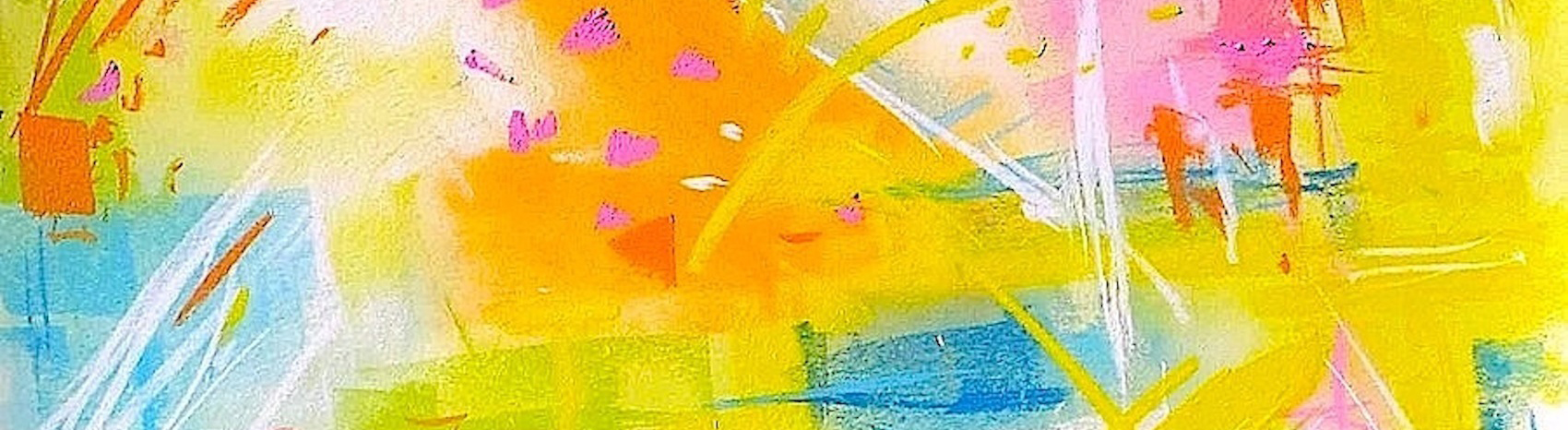
On display through August 31 in the upstairs classroom
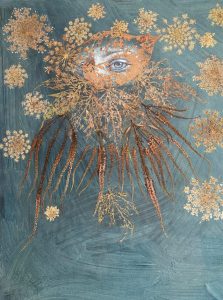 WHOI scientist Dr. Clarissa Karthauser is a marine microbiologist who studies an ocean phenomenon known as Marine Snow, which can harbor diverse microbial communities. She has collaborated with Laurie Kaplowitz, an internationally renowned artist, on an art show about Marine Snow on view at Falmouth Art Center for the summer.
The exhibit, 10 mixed media paintings accompanied by text panels that tell a story of Marine Snow, is on display in the upstairs classroom, until August 31.
The lyrical meditation on the text panels and in a booklet about the show written by Dr. Karthauser introduces viewers to the life cycle of Marine Snow, a key component of global climate and ocean ecosystem health.
Kaplowitz’s paintings tell the story of Marine Snow and how life on land and in the ocean are not as far apart from each other as they may seem.
The collaboration is part of the Synergy Project, which pairs a scientist with an artist. The Synergy Project was started by the Art League of Rhode Island. The Falmouth Art Center has shown two Synergy Project exhibits in recent years.
The microbial communities that make up Marine Snow were the topic of Dr. Karthauser’s PhD thesis, researched and written at the max Planck Institute for Marine Microbiology in Bremen, Germany.
She joined WHOI in 2022 with a goal of characterizing the properties of Marine Snow to make its unique role in carrying and storing carbon more predictable.
Kaplowitz retired as a Chancellor Professor in Fine Arts from the College of Visual & Performing Arts at the University of Massachusetts in Darmouth, where she taught painting and drawing.
Her work has been exhibited in commercial galleries in Boston, Los Angeles, New York, Dallas and San Francisco and in museums, including the Fogg Museum at Harvard University, the DeCordova Sculpture Park and Museum in Lincoln, MA, The New Bedford Art Museum, the Museum of Science in Boston, among others.
A booklet about the exhibit is also for sale at Falmouth Art Center and is sponsored by WHOI, Art League of Rhode Island, and Ocean Twilight Zone.
Ocean Twilight Zone is a WHOI project to advance scientific understanding of the twilight zone, the permanently dark water layers at around 100 to 1,000 meters depth; to improve public awareness of the deep ocean and inform policy development; and to develop low-cost pervasive technologies and build capacity for further studies of the mesopelagic ecosystem.
Dr. Karthouser’s research on Marine Snow is part of the Twilight Zone project, aiming to understand how Marine Snow contributes to the twilight zone ecosystem and carbon sequestration in the ocean.