


Description
Friday, July 24 at 4pm
in the Hermann Gallery at the Falmouth Art Center
“She knows how to put movement together… ingenious… adds up to good dancing and an original statement.”
— The New York Times
“A modern-day Isadora Duncan… a vibrant performer… an unusual and talented choreographer.”
— Jennifer Dunning, The New York Times
Dunya McPherson’s Invisible Cities is a visually striking fusion of live dance and dance-on-film that explores themes of transformation, impermanence, and renewal. Drawing from the visceral tradition of Japanese Butoh and the mystical movement practices of Sufism, McPherson creates a world where beauty and unease coexist, where what appears stable may already be changing.
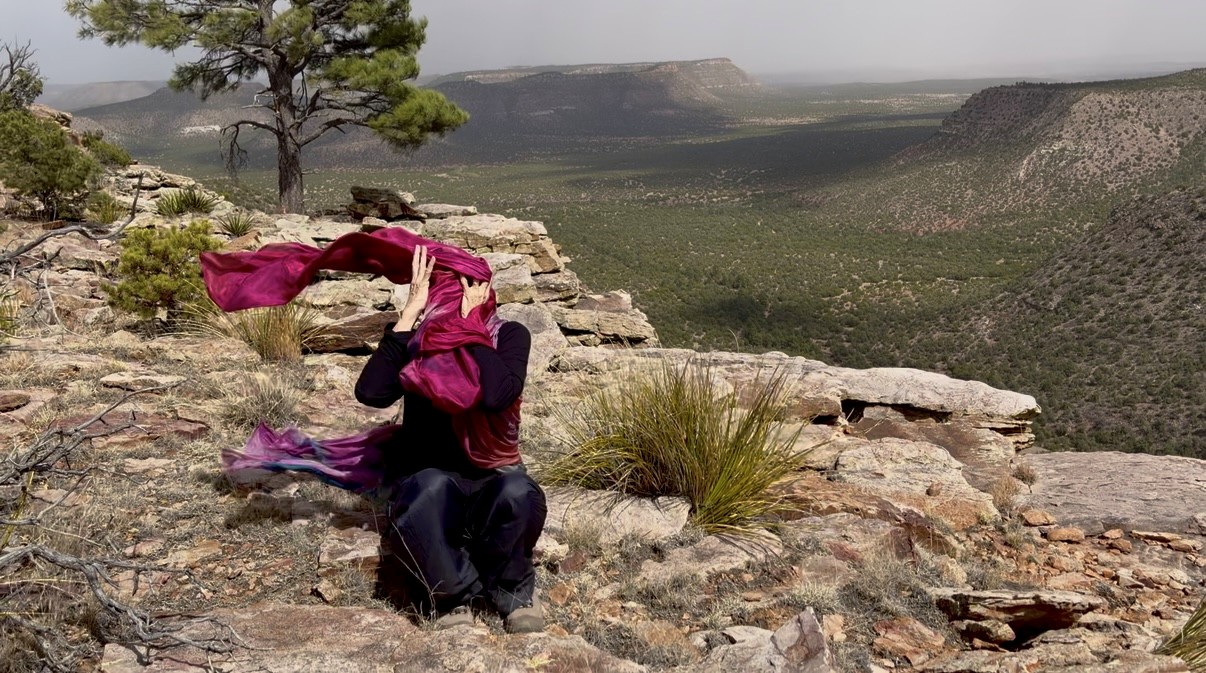
Ceremonial gestures, vividly costumed figures, and evocative projected landscapes unfold in a dreamlike sequence of yearning, awakening, and metamorphosis. Dance films set within vast architectural spaces, windswept desert vistas, and sunlit forests create a haunting counterpoint to the live performance, placing the small human figure within worlds that seem timeless yet fragile.
Inspired by Italo Calvino’s celebrated novel Invisible Cities, the work reflects on the stories we tell about permanence, loss, and the nature of reality. As in Calvino’s imagined cities, what first appears solid gradually reveals itself to be shifting, dissolving, and transforming.
Invisible Cities invites audiences into a poetic meditation on a simple yet profound question: What is real, and how do we live within uncertainty?
Dunya’s Artist Statement:
As a dancer, I have long explored what I call the Three Bodies: the Transparent Body, the Hidden Body, and the Invisible Body. These dimensions of embodiment form the foundation of my daily movement practice.
The Transparent Body is the body of direct experience—the body through which I feel each sensation, each breath, and every nuance of movement. The Hidden Body emerges when I enter a receptive state of consciousness. In this realm, the body itself becomes the guide; dreams, memories, and intuitive perceptions arise through movement. The body reveals itself to the mind.
The Invisible Body appears when I am fully aligned with Mystery. Here, personal identity dissolves—both physical and psychological—and movement arises from a deeper source beyond the self.
Years ago, when I witnessed Kazuo Ohno, one of the founders of Japanese Butoh, perform in New York City, something fundamental shifted within me. I was in my thirties; he was in his eighties. The experience transformed my understanding of dance and altered the course of my artistic life.
That encounter led me to extensive training with a Sufi master in the exploration of mystical states through movement. Although much of this work is traditionally non-performative, the states of awareness it cultivates can be brought into a theatrical setting and shared through performance. It was through witnessing such work that I was first profoundly moved, and it remains the source from which my creative practice continues to unfold.
About the Performer:
Dunya McPherson, BFA, MA, is a critically acclaimed choreographer, performer, educator, author, and pioneer in the field of embodied mysticism. A graduate of The Juilliard School and a recipient of support from the National Endowment for the Arts, she has spent decades exploring the intersection of movement, consciousness, and spiritual practice.
As a Sufi Master Teacher in the Shattari lineage and the founder of Dancemeditation™, McPherson has developed a distinctive body of work that integrates contemporary performance, contemplative practice, and transformative movement inquiry. Through performances, workshops, retreats, and academic teaching, she has guided audiences and participants around the world into deeper experiences of embodied awareness, creativity, and presence.
McPherson’s choreography has been praised for its originality, intelligence, and expressive depth. Her work continues to bridge artistic excellence and contemplative exploration, inviting audiences into encounters with mystery, imagination, and the subtle dimensions of human experience.